Soupbest
mean(θ𝒜, θℱ, θ𝒮) Uniform weight averaging. No hyperparameter, and the best result here.
Preprint · arXiv:2609.07798
Revisiting Corpus Composition for Domain-Adaptive Continued Pretraining
A family of climate-domain ModernBERT encoders. We continue-pretrain ModernBERT-Base on academic climate text, climate-filtered web data, and synthetic climate text, then ask which corpus composition — and which integration mechanism — actually helps.
Key findings
Each is stated as the manuscript states it — scoped to climate NLP, to nine benchmarks, and to the ModernBERT-Base encoder family.
Academic-only adaptation reaches the highest average F1 of any jointly trained configuration. Gains concentrate on register-sensitive tasks — Sentiment +6.3, WXImpactBench +7.5, Commitments +5.9.
Adding web and synthetic text to the academic corpus lowers average F1 from 75.3 to 74.1. Synthetic text is the clearest case: it significantly helps TCFD and Specificity while consistently degrading Commitments & Actions.
Averaging three independently adapted checkpoints beats joint training on the very same corpus union. Their task vectors are near-orthogonal (pairwise cosine 0.06–0.18), so averaging keeps what each source learned.
Method
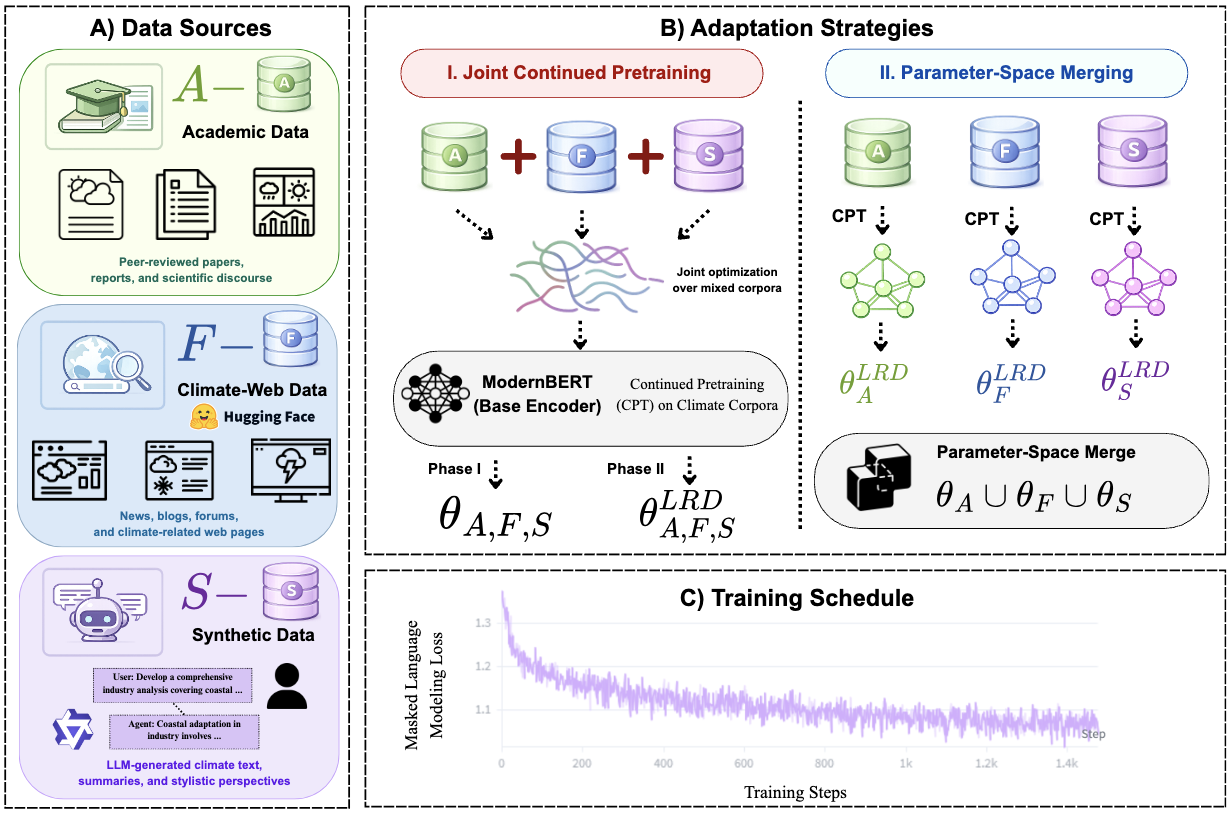
Every variant starts from the same ModernBERT-Base checkpoint and sees the same climate text. What changes is where the sources are combined — in the training data, or in parameter space afterwards.
One training run over a mixture of corpora. All seven non-empty subsets are trained.
Full union: 74.8 avg F1
One checkpoint per corpus, trained independently, then combined by weight averaging.
Same data: 76.3 avg F1
Each configuration runs in two stages, following ModernBERT's own schedule. Phase 1 · CX context extension at a constant learning rate, then Phase 2 · CX_LRD learning-rate-decay specialization. The Phase-2 checkpoints are the paper's primary models; Phase-1 checkpoints are kept as an ablation isolating what the decay stage adds.
Results
Average F1 over nine climate NLP benchmarks, mean of three fine-tuning seeds under one shared recipe. Every figure is transcribed from the manuscript.
| Model | Retr. | Comm. | Det. | Spec. | Sent. | NetZ. | TCFD | WFB | WXI | Avg. |
|---|---|---|---|---|---|---|---|---|---|---|
| Baselines | ||||||||||
| ModernBERT-base (θbase, stable-phase) The initialization used for every adapted variant. | 86.7±1.9 | 65.9±1.3 | 94.5±0.3 | 67.3±0.7 | 71.8±4.1 | 98.7±0.6 | 60.1±0.7 | 96.0±0.4 | 20.4±5.0 | 73.5±1.7 |
| ClimateBERT RoBERTa-based climate-adapted encoder, fine-tuned under the identical protocol. | 82.4±2.6 | 70.9±0.0 | 97.5±0.0 | 67.8±0.0 | 76.6±0.0 | 99.1±0.0 | 51.4±0.1 | 92.5±0.0 | 3.3±4.6 | 72.1±0.8 |
| Climate-ModernBERT · Phase 1 + Phase 2 | ||||||||||
| 𝒜 | 81.1±4.1 | 68.7±2.1 | 93.6±0.2 | 67.3±1.1 | 77.1±0.7 | 98.0±1.2 | 61.3±0.5 | 96.9±0.3 | 25.2±3.2 | 74.4±2.4 |
| 𝒮 | 84.5±2.1 | 66.4±3.4 | 93.8±0.2 | 69.4±0.9 | 74.8±2.7 | 99.0±0.1 | 61.1±0.2 | 96.5±0.3 | 25.0±2.4 | 74.5±1.4 |
| ℱ | 85.0±2.5 | 67.4±1.6 | 95.8±0.0 | 68.7±1.9 | 77.5±0.4 | 98.7±0.0 | 60.3±1.7 | 96.8±0.2 | 20.3±4.4 | 74.5±1.4 |
| 𝒜 + 𝒮 | 83.2±4.1 | 66.1±1.0 | 93.2±0.8 | 69.5±1.0 | 78.1±0.5 | 98.9±0.2 | 61.3±1.0 | 96.2±0.4 | 24.3±4.9 | 74.5±1.5 |
| 𝒜 + ℱ | 83.5±4.4 | 69.5±0.6 | 95.5±0.6 | 70.2±0.7 | 76.0±0.4 | 99.1±0.1 | 63.0±2.5 | 97.0±0.5 | 18.5±5.0 | 74.7±1.6 |
| 𝒮 + ℱ | 85.3±2.2 | 62.2±2.3 | 95.7±0.2 | 71.0±0.8 | 75.5±0.6 | 97.9±0.3 | 59.4±2.2 | 96.9±0.5 | 23.4±3.7 | 74.1±1.4 |
| 𝒜 + 𝒮 + ℱ | 86.8±1.4 | 60.0±2.3 | 95.7±0.0 | 71.8±1.4 | 76.0±1.2 | 98.6±0.4 | 62.8±2.2 | 97.5±0.2 | 23.9±5.9 | 74.8±1.7 |
| Model | Retr. | Comm. | Det. | Spec. | Sent. | NetZ. | TCFD | WFB | WXI | Avg. |
|---|---|---|---|---|---|---|---|---|---|---|
| Baselines | ||||||||||
| ModernBERT-base (θbase, stable-phase) The initialization used for every adapted variant. | 86.7±1.9 | 65.9±1.3 | 94.5±0.3 | 67.3±0.7 | 71.8±4.1 | 98.7±0.6 | 60.1±0.7 | 96.0±0.4 | 20.4±5.0 | 73.5±1.7 |
| ClimateBERT RoBERTa-based climate-adapted encoder, fine-tuned under the identical protocol. | 82.4±2.6 | 70.9±0.0 | 97.5±0.0 | 67.8±0.0 | 76.6±0.0 | 99.1±0.0 | 51.4±0.1 | 92.5±0.0 | 3.3±4.6 | 72.1±0.8 |
| Climate-ModernBERT · Phase 1 only | ||||||||||
| 𝒜 | 85.5±1.0 | 71.8±1.1 | 93.2±0.3 | 68.9±1.6 | 77.4±1.0 | 98.5±0.8 | 59.0±0.9 | 97.0±0.2 | 26.1±3.2 | 75.3±1.1 |
| 𝒮 | 86.0±1.8 | 65.2±1.0 | 93.5±0.8 | 68.0±0.6 | 71.8±4.1 | 98.7±0.4 | 60.0±0.7 | 97.2±0.2 | 20.0±2.1 | 73.4±1.3 |
| ℱ | 85.4±1.0 | 64.8±3.4 | 94.5±0.3 | 68.0±1.5 | 76.3±0.5 | 99.2±0.1 | 59.1±1.0 | 97.2±0.1 | 23.4±5.1 | 74.1±1.4 |
| 𝒜 + 𝒮 | 86.1±1.9 | 67.9±1.4 | 94.0±0.6 | 67.6±0.9 | 77.0±2.0 | 98.2±0.9 | 61.4±0.5 | 96.6±0.5 | 24.8±3.4 | 74.8±1.3 |
| 𝒜 + ℱ | 86.0±0.8 | 65.9±0.7 | 93.8±0.4 | 67.2±1.1 | 76.8±1.0 | 99.1±0.2 | 59.7±1.2 | 96.5±0.3 | 24.1±3.2 | 74.3±1.0 |
| 𝒮 + ℱ | 85.4±1.0 | 64.8±3.4 | 94.5±0.3 | 68.0±1.5 | 76.3±0.5 | 99.2±0.1 | 59.1±1.0 | 97.2±0.1 | 23.4±5.1 | 74.2±1.4 |
| 𝒜 + 𝒮 + ℱ | 86.5±1.0 | 67.4±1.3 | 95.2±0.1 | 70.3±0.2 | 75.2±0.6 | 99.1±0.1 | 59.2±1.1 | 96.5±0.9 | 18.5±5.3 | 74.1±1.2 |
| Model | Retr. | Comm. | Det. | Spec. | Sent. | NetZ. | TCFD | WFB | WXI | Avg. |
|---|---|---|---|---|---|---|---|---|---|---|
| Joint training on the union | ||||||||||
| 𝒜 + 𝒮 + ℱ | 86.8±1.4 | 60.0±2.3 | 95.7±0.0 | 71.8±1.4 | 76.0±1.2 | 98.6±0.4 | 62.8±2.2 | 97.5±0.2 | 23.9±5.9 | 74.8±1.7 |
| Parameter-space merges (Table 4) | ||||||||||
| θSoup Simple weight averaging | 83.6±1.6 | 66.5±3.7 | 95.4±0.6 | 70.9±2.1 | 76.7±1.4 | 98.9±0.0 | 64.1±2.2 | 97.3±0.1 | 33.7±5.3 | 76.3±1.9 |
| θTA(1.0) Task Arithmetic, λ = 1.0 | 85.0±0.4 | 71.2±1.2 | 94.9±0.5 | 68.5±0.7 | 77.0±3.1 | 99.2±0.1 | 61.3±0.7 | 97.1±0.2 | 27.2±5.1 | 75.7±1.3 |
| θTIES(0.7) TIES, drop ratio d = 0.7 | 85.1±2.8 | 71.9±2.7 | 94.9±0.1 | 70.7±0.1 | 75.6±1.6 | 99.0±0.2 | 59.7±1.1 | 96.7±1.3 | 26.9±3.8 | 75.6±1.5 |
| θTIES(0.5) TIES, drop ratio d = 0.5 | 86.1±1.4 | 67.6±2.5 | 93.6±0.6 | 68.9±0.9 | 77.1±0.7 | 99.0±0.1 | 61.4±0.6 | 96.5±1.2 | 28.5±1.7 | 75.4±1.1 |
| θDARE(0.5) DARE-TIES, drop ratio d = 0.5 | 86.3±0.9 | 67.2±0.4 | 94.8±0.3 | 69.2±0.2 | 74.3±0.1 | 98.9±0.2 | 57.8±1.3 | 97.1±0.2 | 26.9±2.3 | 74.7±0.7 |
| θDARE(0.7) DARE-TIES, drop ratio d = 0.7 | 85.5±0.9 | 63.3±1.1 | 94.7±0.1 | 67.6±0.3 | 74.1±2.0 | 98.9±0.2 | 61.6±1.0 | 97.0±0.3 | 26.2±6.2 | 74.3±1.3 |
| θTA(0.5) Task Arithmetic, λ = 0.5 | 80.9±5.7 | 67.5±1.8 | 94.7±0.4 | 67.9±0.2 | 71.0±0.2 | 99.1±0.0 | 60.3±2.4 | 95.8±0.5 | 24.8±6.0 | 73.6±1.9 |
| Appendix F (Table 10) | ||||||||||
| θNorm Norm-balanced linear merge · Phase-2 components | 84.3±1.8 | 67.3±1.7 | 94.1±1.1 | 67.5±1.0 | 78.0±1.5 | 98.2±0.1 | 61.4±0.7 | 96.4±0.3 | 23.8±3.4 | 74.6±1.3 |
| θNorm (CX) Norm-balanced linear merge · Phase-1 components | 86.5±0.4 | 70.1±1.7 | 94.4±1.1 | 68.8±1.0 | 77.8±1.5 | 98.3±0.5 | 61.2±0.7 | 96.5±0.5 | 26.8±2.5 | 75.9±1.2 |
| θTA(0.5) (CX) Task Arithmetic λ = 0.5 · Phase-1 components | 86.4±0.8 | 67.1±1.6 | 94.7±1.1 | 68.2±1.0 | 78.6±3.1 | 98.1±0.1 | 61.0±1.0 | 96.3±0.2 | 20.9±7.1 | 74.6±1.8 |
| θSoup (CX) Simple weight averaging · Phase-1 components | 84.5±1.6 | 66.5±2.6 | 94.1±0.3 | 69.6±0.7 | 78.2±2.8 | 98.3±0.1 | 61.3±1.5 | 96.5±0.2 | 22.5±8.3 | 74.2±1.5 |
Average F1 change of a two-source Soup relative to the full Soup({𝒜, 𝒮, ℱ}).
Removing 𝒜 costs four times as much as removing either other corpus — even though ℱ produces by far the largest parameter update.
Six single-label classification tasks, two multi-label, one retrieval benchmark cast as binary relevance.
Model merging
Joint training makes one optimizer reconcile three distributions at once. Merging lets each corpus produce its own checkpoint first. Because those updates are nearly orthogonal, the combination keeps more of what each source contributed.
mean(θ𝒜, θℱ, θ𝒮) Uniform weight averaging. No hyperparameter, and the best result here.
θbase + λ · Σ δi Sum the task vectors and scale by λ ∈ {0.5, 1.0}.
trim → elect sign → merge Drop small entries, resolve sign conflicts, average the rest. d ∈ {0.5, 0.7}.
drop & rescale → TIES Randomly drop and rescale before TIES, assuming task vectors are redundant.
Uniform average of the three single-source Phase-2 checkpoints, verified from the repo's
own mergekit_config.yml. Gains are largest on Commitments (+7.0) and
WXImpactBench (+9.3).
Model explorer
The paper's checkpoints are republished under
CMB-ClimateModernBERT with names that
read as the paper's own notation — corpora in A_S_F order, then the training
stage. The original sraj/* repositories are untouched, so every existing link
still works.
No checkpoints match these filters.
9 checkpoints are marked unconfirmed — their mapping to a manuscript configuration could not be established from the paper, the collection and the merge configs alone. 8 are superseded; nothing has been deleted from the Hub. Reasoning in the naming guide.
Paper
Preprint arXiv:2609.07798 Submitted 7 September 2026.
@article{yu2026climatemodernbert,
  title   = {Climate-ModernBERT: Revisiting Corpus Composition for
             Domain-Adaptive Continued Pretraining},
  author  = {Yu, Yongan and Raj, Shantam and Ni, Jingwei and
             Vaghefi, Ario Saeid and Stammbach, Dominik and Leippold, Markus},
  journal = {arXiv preprint arXiv:2609.07798},
  year    = {2026},
  url     = {https://arxiv.org/abs/2609.07798},
}